 KICK
Event cards
In short
An event card in Kickhood is a single decision moment in your footballer's life: a short situation and usually two or three options. Each option shows which values it raises or lowers and by how much; after you choose, a result card lists the changed values, any lasting effect and any decision that will come back later.
What an event card is
An event card in Kickhood is one decision your player faces during the career. The card shows a short situation with two or three options underneath (the catalog has a single card with four). The option you pick changes your life values, sometimes your attributes, and sometimes leaves a mark that returns later.
As of November 2026 the career catalog holds 655 cards; the childhood chapter has its own 456 cards on top of that (see Childhood). A single life only ever sees part of the catalog; the Life deck article explains how.
When a card appears
Card frequency in Kickhood depends on your age and how well known you are. There is never more than one card per day. While a card is waiting, the day does not move on: the map shows an "open event card" button and you have to answer it first.
| Situation | Cards per week |
|---|---|
| Age 16–17 | 2 |
| Age 18+, under 50k followers | 2 |
| 50k followers or more | 3 |
| 500k followers or more | 3, some weeks 4 |
Cards that open a playable match moment never reach a player who got no first-team minutes that week.
The face of the card
The top of the card names the area it comes from (for example "Law and ethics" or "Team and coach") and one of five life areas: Career, Competition, Professional, Social or Financial. The situation text sits in the middle with a grey context line below it. The context line mentions the day, the weather in your city or the next opponent. If the card was triggered by a condition, a short reason is added, such as "coach trust is low", "you have an injury history", "you are abroad" or "the trace of a past decision".
Options: cost and reward
Every option in Kickhood tells you what it does before you pick it. Small chips sit under the option name: a green arrow shows a value going up, a red arrow a value going down, with the amount (for example "Discipline ↑ 2", "Mind ↓ 5"). Cost and reward appear side by side; no option is free, and there is rarely an obvious right answer.
- Warning icon: if an option's biggest effect is negative on a value that would normally get a check-mark icon, the icon is replaced by a warning triangle on a red background.
- Dice option: some outcomes depend on luck. These show an explicit chance such as "60% success", always between 5% and 95%.
- Match moment: some cards say they open a match moment. Before you choose, you see the names of the values affected on success and on failure, but not the numbers. The moment you play decides the outcome.
- Hidden option: on a few cards an option only appears if a value is high enough or you made a specific decision earlier.
- Situational outcome: some options resolve differently depending on your current state; the result card shows what actually happened.
The result card
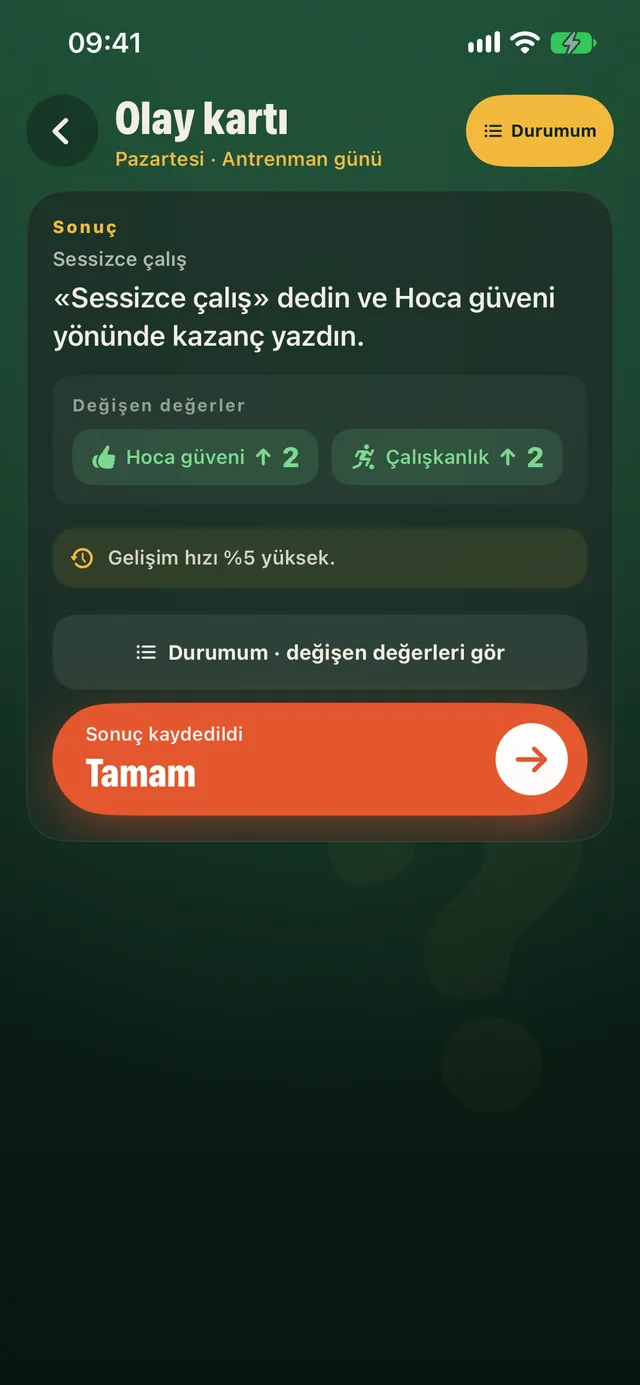
After you choose, a result card opens in the same place. It shows your choice and an outcome sentence, followed by a "changed values" section. Tapping any value opens the My Status panel panel on that value. A gold box shows any lasting effect:
- A multiplier such as "development speed 5% higher". Multipliers drift back to normal week by week.
- "This decision will come up again in 30 days." The choice opened a chain (see Card chains).
- "This decision will leave a mark on your career." The game remembers it.
If a match moment could not be played, the result is rolled from the relevant attribute and the card says the moment was auto-played. Accepting an option that promises a move creates a real transfer offer (see Transfer). Every decision is also posted to Akış, the in-game social feed, and the following week a "last week's decision" line reminds you of it.
Why this card?
Kickhood does not pick cards at pure random; a narrative director chooses them. A card's age range and conditions must fit. Cards with more specific conditions (a position, a country, a past decision) come before general ones. Weights react to your situation:
| Situation | Effect |
|---|---|
| Last two cards ended negative overall | Positive cards weighted 1.5× |
| Discipline below 35 | Nightlife cards 2× |
| Money indicator below 20 | Money cards 1.5× |
| Injury history | Health cards 1.25× |
| Card seen in your last three careers | Weight 0.3× |
Rarity also matters: common cards use a 1× multiplier, rare cards 0.25× and very rare cards 0.03×.
Why it works this way
Kickhood's design treats event cards as the brain of the game: like real life, a decision shifts the odds rather than fixing the result. Showing the cost before you choose means every risk is taken knowingly. The director's tension rule exists so that a run of bad news is followed by some relief, and one bad week cannot end a career.
FAQ
Can I skip an event card in Kickhood?
No. The day does not advance until the waiting card is answered, so you have to pick an option.
Can I see what an option does before choosing?
Yes. Fixed options show each value and amount as chips. Dice options show their success chance, and match-moment cards show which values are at stake.
Can the same card appear twice in one career?
Normal cards appear once per career. A few cards marked as repeatable, such as the start-of-season captaincy vote, are the exception.
What is the grey line under the card text?
It is the context line: it mentions the day, the weather or the next opponent. If a condition triggered the card, a short reason such as "coach trust is low" is added at the end.
Images come from a development build of the game.